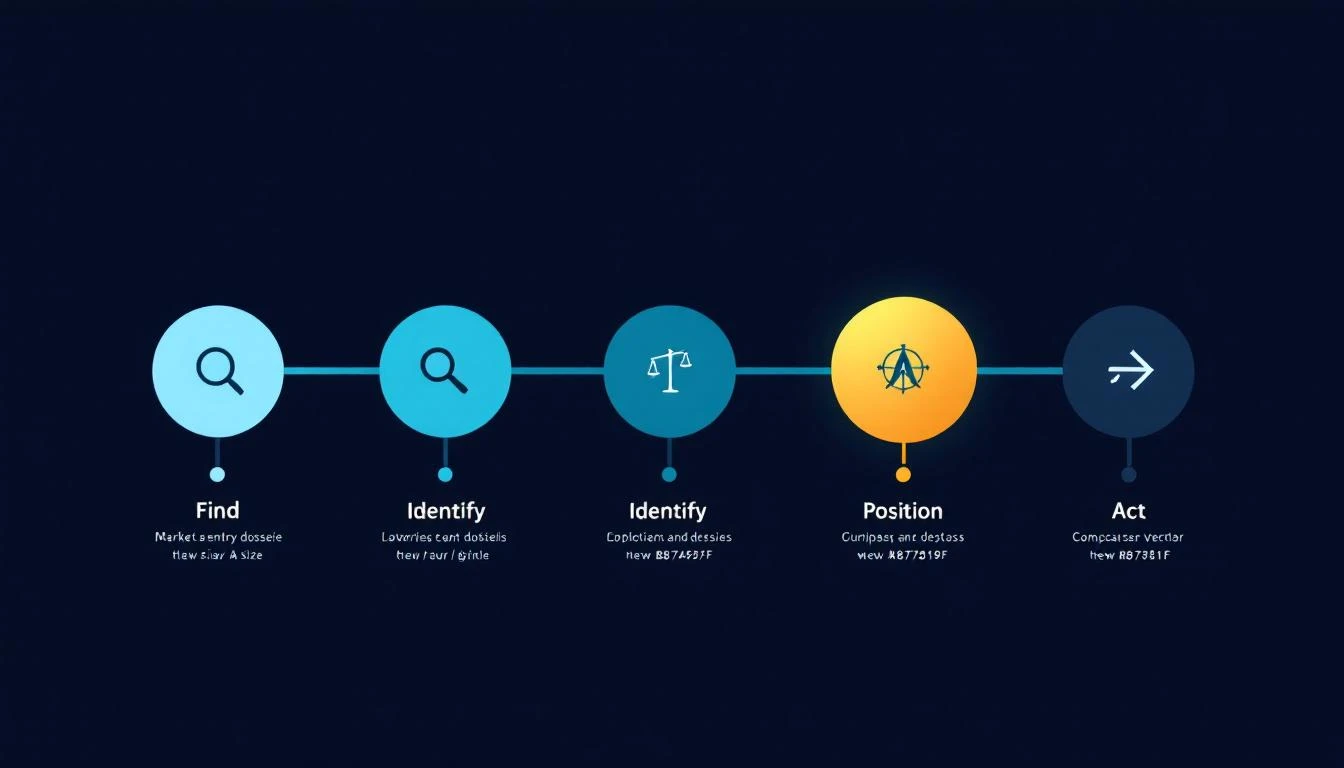
This is a public sample of a ForIntel Market Entry Brief, prepared for Lhotse, a procurement / source-to-pay software vendor evaluating US market entry. It sizes the category demand, reads the live competitive surface, checks the national spend backdrop, and maps the route-to-market structure, then names the single strategic call a US entry turns on.
The entry verdict
The US procurement-software market is mature, flat and well-defended: a viable entry, but one to win on differentiation and a validated route-to-market, not on a growth wave.
This is a market-entry read of the US procurement / source-to-pay software category for Lhotse, sized from the buyer-intent demand, the live competitive surface, the national spend backdrop, and the route-to-market structure. The central fact is that the buyer-intent demand pool is small and flat: roughly 3,680 monthly searches across the eight category head terms, with no significant 12-month trend and high commercial CPCs. The search surface is owned before a new entrant reaches it: an AI Overview sits at the top of the page on three of four head terms, video and review infrastructure (YouTube, G2) own the organic surface beneath it, and two incumbents, Ivalua and Coupa, hold the head-term positions, with the 'Coupa alternative' lane already 7-of-9 rival vendors. The counter-weight is the macro backdrop: national business information-processing investment is genuinely rising in both nominal and inflation-adjusted terms, a supportive (if non-category-specific) envelope. The route-to-market read, carried at medium confidence, points to a reseller/direct-led structure rather than a dense partner network, which is the single most important thing to validate nationally before committing an entry motion. The strategic call: enter on differentiation and efficiency in a stable, contested market, take share rather than ride growth, and choose the entry vector only after the national partner-density check resolves.
- The buyer-intent demand pool is small, and flat. Across the eight category head terms a buyer actually searches, 'procurement software' (1,600/mo), 'purchase order software' (880), 'spend management software' (590) and five more, total US demand is roughly 3,680 searches a month, and the aggregate 12-month trend is flat (no statistically significant movement). The terms also carry high commercial cost-per-click ($71 on 'procurement software,' $100 on 'purchase order software,' $142 on 'Coupa alternative'), so paid acquisition is expensive against a thin, non-growing pool. Size this as a stable share-capture market, not a demand-growth bet.
- An AI Overview, not a vendor, sits at the top of the page, and reviewers own the surface beneath it. Across 393 organic results on four head terms, a Google AI Overview occupies the very top of the page on three of the four, compressing every human result below it. The human organic surface is then owned by video and review infrastructure: YouTube alone appears 56 times, ahead of any single procurement vendor, with review sites and listicles (G2, comparison roundups) next. A new entrant's first obstacle is the AI answer box and the reviewer surface, not just the incumbents' own pages.
- Two incumbents, Ivalua and Coupa, own the head-term positions, and the 'alternative' lane is already crowded. Ivalua holds the #1 organic position for 'source to pay software' and Coupa holds #1 for 'procure to pay platform' (Coupa also ranks for 'procurement software'). They are the only two domains that recur across the head terms. And the displacement lane is contested: the 'Coupa alternative' search is 7 of 9 organic results from rival vendors (Pivot, Stampli, Procurify, Precoro, HighRadius), with two non-vendor results, a Gartner advisory page (ranked third) and a Reddit thread. The alternative-seeking audience exists, but the lane is a well-funded, high-SEO battleground, not an open door.
- The national spend backdrop is genuinely rising, in both nominal and inflation-adjusted terms. US private fixed investment in business information-processing equipment and software has risen steadily over the trailing 12 quarters, from $1,411.6B to $1,787.8B, a statistically significant up-trend, and, on the inflation-adjusted check, real total private investment also rose ($4,180.8B → $4,483.1B) over the same window. So the enterprise-software spend envelope is real, not merely an inflation artifact. This is a supportive macro backdrop for a B2B software entrant, though it is a national capacity signal, never a category-specific demand figure.
In one line: the US procurement-software demand pool is small and flat, its search surface is owned by an AI answer box, reviewers, and two entrenched incumbents (Ivalua, Coupa), and the 'alternative' lane is already crowded, but the national spend backdrop is genuinely rising. Enter on differentiation and efficiency in a mature market, win share through a validated route-to-market, and do not bank on category growth pulling you in.
How to read this report. A High confidence chip means a well-sampled, directly observed signal: the demand sizing (an eight-term exact-volume read on a 1,000-keyword universe), the competitive surface (393 live organic results plus an independent 'alternative' re-pull), and the national spend backdrop (official investment statistics, trend-tested) all carry it. A Medium chip marks a signal that is real but rests on a single-sample base with its limitation stated inline. The route-to-market read is built from one metro's business listings plus the incumbent's public link ecosystem, and needs national validation before it is load-bearing. Search-volume and traffic figures are third-party modeled estimates, and the spend backdrop is a national capacity signal, never a category-specific demand figure. One intended layer (new-business-formation / firmographics) did not resolve this run and is named as a scoped boundary (closing section) with the exact reason, rather than dressed as a finding.
01 · Category Demand Sizing
How big is the buyer-intent pool, really? (Confidence: High.)
We built the US buyer-side keyword universe for the procurement / source-to-pay category, a 1,000-keyword expansion (out of more than 27,000 candidate terms) seeded from eight frozen head terms, and pulled exact monthly US search volume for that head set. (Source: third-party search-volume estimates.) The result is the single most important market-entry fact: the genuine buyer-intent head terms total roughly 3,680 searches a month. This is a small, concentrated demand pool, not a mass market.
| Head term | Monthly US searches | Commercial CPC | Competition |
|---|---|---|---|
| procurement software | 1,600 | $71 | Low |
| purchase order software | 880 | $100 | Low |
| spend management software | 590 | $32 | Low |
| supplier management software | 210 | $56 | Low |
| source to pay software | 210 | — | Low |
| procure to pay platform | 70 | — | Low |
| Coupa alternative | 70 | $142 | Medium |
| intake to procure | 50 | — | Low |
| Total | ~3,680 / mo | — | — |
Figure: Exact monthly US search volume across the eight category head terms (~3,680/mo total). The aggregate 12-month trend is flat (no statistically significant movement). A small, mature demand pool, size the opportunity as share-capture, not growth.
Two further facts sharpen the read. First, the trend is flat: across the head set the aggregate 12-month trajectory shows no statistically significant movement, the category is stable, neither rising nor declining. Second, the commercial terms carry high cost-per-click, about $71 on 'procurement software,' $100 on 'purchase order software,' and $142 on 'Coupa alternative', the signature of a high-value, heavily-bid B2B category. The implication for entry is direct: paid acquisition is expensive against a thin, non-growing pool, so a pure paid-search land-grab will face high customer-acquisition cost with little organic tailwind. A US entry should not be modelled on the assumption that category growth will pull it in. The demand is real but bounded, and the win has to come from taking share, not riding expansion.
02 · Competitive Concentration
Who owns the surface a new entrant must break into? (Confidence: High.)
We captured the live organic search composition for the category head terms and, separately, the search for the displacement query 'Coupa alternative.' (Source: a live competitive-surface read, 393 organic results across four head terms, plus an independent re-pull of the 'alternative' search.) The surface is owned before a new entrant reaches it. On three of the four head terms, a Google AI Overview occupies the very top of the page, answering the query inline and pushing every human result down. Beneath it, the organic surface is dominated by video and review infrastructure rather than vendors: YouTube appears 56 times across the four terms, more than any single procurement provider, followed by review sites and comparison listicles (G2, roundup blogs).
| Domain owning the organic surface | Appearances across 4 head terms |
|---|---|
| YouTube | 56 |
| Zycus | 13 |
| Order.co | 8 |
| G2 | 6 |
| Gitnux | 6 |
| Ivalua | 5 |
| Tipalti | 5 |
| Stampli | 5 |
| Procurify | 5 |
| Ramp | 5 |
Figure: Organic appearances across the four head terms (393 organic results). An AI Overview sits at the very top of the page on three of four head terms, ahead of every human result. Beneath it, video and review sites lead. Ivalua and Coupa are the recurring incumbents, each #1 organic on its own term.
On who the entrenched incumbents are, the read is precise. Ivalua holds the #1 organic position for 'source to pay software' and Coupa holds the #1 organic position for 'procure to pay platform' (Coupa also appears for 'procurement software'). They are the only two providers that recur across the head terms, the established category anchors. The displacement lane is no easier: the 'Coupa alternative' search returns seven of nine organic results from rival vendors, Pivot, Stampli, Procurify, Precoro and HighRadius among them, with two non-vendor results, a Gartner advisory page (ranked third) and a Reddit thread. That cuts both ways for an entrant: it confirms a real alternative-seeking audience exists, and that the lane is a crowded, well-funded, high-SEO battleground rather than an open opportunity. The competitive opening is therefore not a head-on SEO contest for the head terms, the AI box, the reviewers and the incumbents own those, but a differentiated wedge earned in the reviewer-and-comparison infrastructure and in the specific buyer segments the incumbents serve least well.
03 · Macro Spend Backdrop
What the national spend signal says about capacity. (Confidence: High.)
We corroborated the demand read against the national spend backdrop for the kind of investment that funds enterprise-software adoption, drawn from official national investment statistics. (Source: official national investment statistics, across the trailing twelve quarters.) The signal is supportive.
| National investment series (trailing 12 quarters) | Start | End | Change |
|---|---|---|---|
| Business information-processing equipment & software (nominal) | $1,411.6B | $1,787.8B | ~+27% (significant up-trend) |
| Real (inflation-adjusted) total private investment | $4,180.8B | $4,483.1B | ~+7% (significant up-trend) |
Figure: Nominal business information-processing investment rose ~27% across the window. The inflation-adjusted total-investment series rose too, so the spend envelope is real, not an inflation artifact. National backdrop only, never a category-specific figure.
A nominal rise alone could simply reflect inflation rather than real volume growth, so we read it against a broader real (inflation-adjusted) total private-investment series, which also rose over the same window, a separate, wider series, not a strict deflation of the category-proximate one. Both point up, so the enterprise-spend envelope is genuinely expanding, not merely re-pricing. For a B2B software entrant, that is a constructive macro envelope: the budget capacity that funds procurement-software purchases is growing nationally. The important caveat, stated plainly, is one of grain: this is a national capacity signal, not a category-specific demand figure. It tells you the spending environment is favourable. It does not override the bounded, flat category demand established in Section 01. Read the two together: a supportive macro backdrop wrapped around a small, mature category, budget exists, but the procurement-software pie itself is not growing.
04 · Route To Market
How the channel is structured, and what to validate. (Confidence: Medium.)
We read the route-to-market two ways: the local density of software-and-consulting providers in a major US enterprise corridor, and the public link ecosystem of the category leader as a proxy for how the incumbent's channel is actually built. (Source: a metro business-listings sample for a major US enterprise-software corridor, plus the category leader's public inbound-link ecosystem.) Two patterns emerge. First, the corridor is saturated with software vendors, not implementation partners:
| Provider type in the sampled enterprise corridor | Listings |
|---|---|
| Software companies | ~8,157 |
| Business-management consultants | ~2,382 |
| Computer consultants | ~1,030 |
The supply side is product companies, with implementation/advisory partners far thinner, and no global systems integrators surfacing in the visible sample. Second, the category leader's public link ecosystem (more than 6,000 referring domains) is dominated by job boards, recruitment sites and review/aggregator pages, not partner or reseller directories. Its closest link-profile peers are general business and tech-media domains, not a dense web of named implementation partners.
Read together, these point to a reseller / direct-led route to market rather than a partner-dense one: the incumbents appear to sell and implement largely through their own motion and professional services, not through a broad third-party partner network. For a new entrant, that shapes the entry-vector choice directly: a direct-sales lead is not recommended against a small, flat, well-defended head-term surface (Sections 01–02), where customer-acquisition cost would be high; a partner-channel lead is the more promising route, potentially bypassing the crowded comparison SERPs — conditional on partner density actually existing nationally; and a reseller motion is the fallback if the national check confirms partners are sparse.
The honest limitation is why this section carries a medium chip rather than high. The channel read rests on a single metro corridor plus one incumbent's link ecosystem, a directional, not a national, base. A single-market sample cannot by itself support a national route-to-market claim. So the finding is framed as a hypothesis with a clear validation trigger: before committing an entry motion, run a national partner-density check (the major US metros, professional networks and analyst partner directories). That validation is the single highest-value next step in the file.
05 · What This Means For Your Entry
1 · Enter on differentiation in a mature market, do not model the entry on category growth. The buyer-intent demand pool is small (~3,680 head-term searches a month) and flat, with high commercial CPCs. Build the entry case on taking share from incumbents with a differentiated wedge, not on a rising-tide assumption. The supportive national spend backdrop is an envelope, not a category-growth signal, do not let it override the bounded category demand.
2 · Do not lead with a direct-sales, head-term SEO/paid land-grab. The head-term surface is owned before you reach it: an AI Overview at the top of the page on three of four terms, reviewers and YouTube beneath it, and Ivalua and Coupa holding the #1 organic positions. A head-on contest for those terms is expensive and slow. Treat the head terms as table-stakes presence, not the growth engine.
3 · Validate national partner density before choosing the entry vector: this is the single highest-value next step. The route-to-market read (medium confidence) points to a reseller/direct-led structure with thin implementation-partner presence, but it rests on a single-metro sample. Run a national partner-density check (top US metros, professional networks, analyst partner directories). The result selects the vector: partner-channel lead if partners exist, reseller fallback if they do not, direct-sales only as a supporting motion.
4 · Win the 'alternative' and reviewer surface, not the head terms. The 'Coupa alternative' lane proves an alternative-seeking audience exists, but it is 7-of-9 rival vendors today. Earn position in the reviewer-and-comparison infrastructure (review sites, comparison content, and the buyer communities the lone Reddit result hints at) and target the specific segments the incumbents serve least well, rather than fighting the AI box and the incumbents for the head terms head-on.
5 · Close the firmographic / formation layer before sizing the full go-to-market. The new-business-formation read, the proxy for how fast the mid-market buyer base is expanding, did not resolve this run (closing section). It is a named boundary, not a finding. Commission the firmographic pass so the addressable-market sizing rests on real formation and firm-count data, not the demand and competitive surface alone.
Scope, Confidence & What a Deeper Engagement Adds
This Market Entry Brief reads four layers: demand sizing, competitive concentration, and the national spend backdrop at High confidence, and the route-to-market structure at Medium with its single-sample limitation stated inline, and propagates only what survived an independent verification pass. The following are scoped boundaries, each named with the specific reason and the work that closes it. They are diligence boundaries, not findings, and are never presented as such.
- Business-formation / firmographic layer: not resolved this run. One intended layer, the new-business-formation rate for the professional-and-technical-services sector that forms the mid-market buyer base, did not resolve in this run. The formation-statistics source requires an additional query parameter our current data connector does not yet supply (a tooling enhancement we are tracking), so it returned no data: a named boundary, not evidence that the data is unavailable. No firmographic or formation-rate figures are stated anywhere in this brief. The entry read rests entirely on the demand, competitive and macro substrate that did return. Closing it: once the connector supplies the required time-period parameter, add a firm-count / firm-size-band breakdown to size how fast the mid-market buyer base is actually expanding.
- State-level absolute demand: relative-only at this tier. The geographic interest read returned relative interest on a 0–100 scale (Utah, Arizona, Louisiana and Colorado index highest on 'procurement software'), which cannot be compared across states of different population sizes to give absolute volume. It is directionally useful for prioritising a regional launch sequence, but a true per-state addressable-demand figure is a deeper pull. Closing it: a population-normalised, absolute per-state demand model.
- Organic-competitor field & ranking trajectories: partial. The full organic-competitor field around the category leader (the complete set of rival domains, their traffic estimates and keyword overlap) did not resolve in this run, and the 12-month head-term ranking trajectories were structurally incomplete. The competitive read therefore rests on the live head-term surface and the 'alternative' re-pull rather than a full competitor-traffic teardown. Closing it: a dedicated competitor-traffic-and-overlap teardown against Ivalua, Coupa and the named alternative-lane vendors.
- Route-to-market: single-sample, pending national validation. As stated in Section 04, the channel read is directional, built from one metro corridor and one incumbent's link ecosystem. It is carried at medium confidence with an explicit validation trigger, not presented as an established national finding. Closing it: the national partner-density check named as priority action 3.
This is a public-surface market-entry read at the Market Entry Brief tier, prepared for Lhotse. The natural next step is the deeper engagement that turns this read into a committed go-to-market plan: (1) the national partner-density check that selects the entry vector, (2) the corrected firmographic / business-formation pull to size how fast the mid-market buyer base is growing, and (3) a competitor-traffic-and-overlap teardown against Ivalua, Coupa and the alternative-lane vendors, with a population-normalised per-state demand model to sequence the regional launch. To commission it, reach the ForIntel desk directly at forintel@foragentis.com.