The 2026 Guide to Ecommerce Checkout Fees and How to Recover Margin
A walkthrough for ecommerce operators on where checkout fees come from, what's actually negotiable, and how to recover 0.4–1.1% of gross revenue without changing pricing.
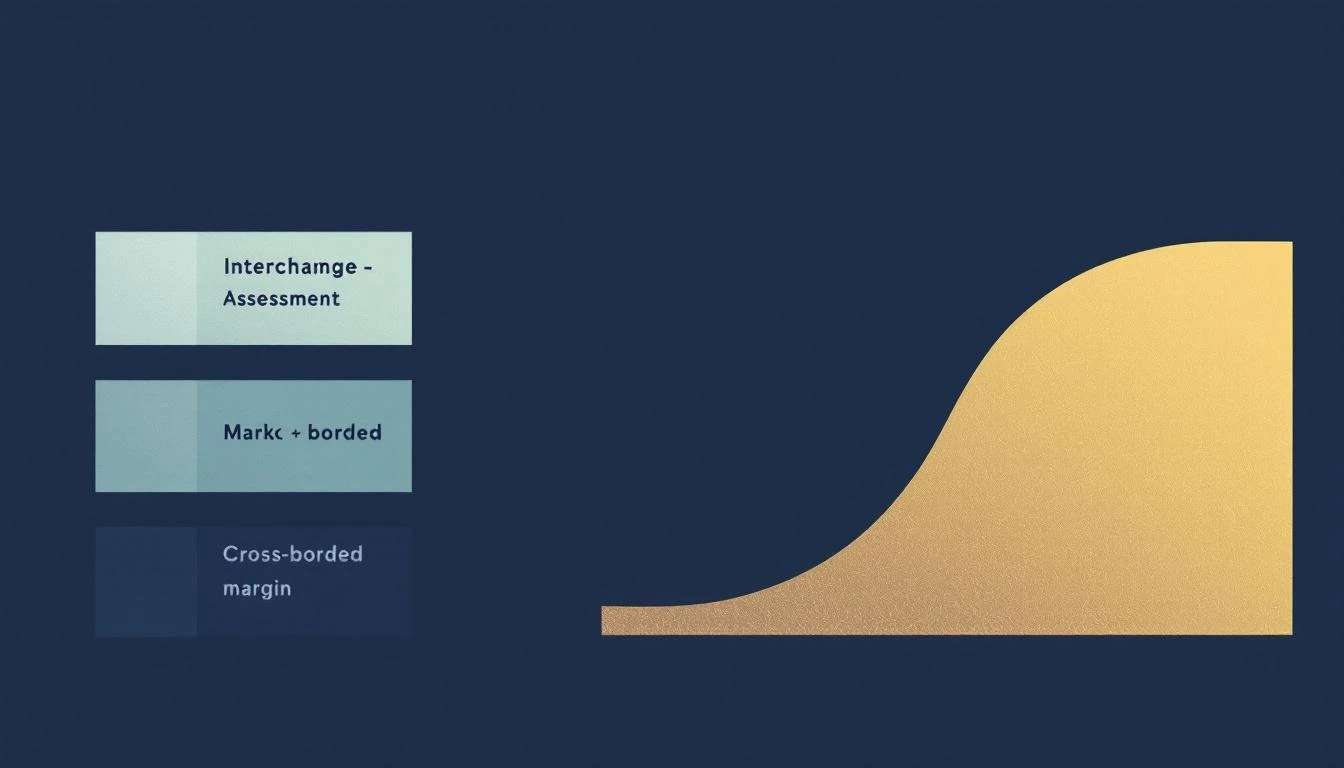
Ecommerce operators usually treat payment processing as a fixed cost. It is not. A typical Shopify-plus-Stripe stack quietly hands 2.9% + 30¢ to the processor on every card transaction. That flat rate bundles interchange inside it, which is exactly why most merchants never see the categories their transactions actually qualify for, and why the cross-border, currency-conversion and non-qualified surcharges that sit on top of it go unexamined. For a store doing $5M annually, recovering 0.4 to 1.1% of gross revenue is $20,000 to $55,000 per year.
This post is a practical walkthrough of where the money goes and how to get some of it back without raising prices, changing checkout flow, or migrating processors.
Why checkout fees compound silently
Most ecommerce dashboards show "processing fees" as a single line item. That single line hides at least four moving parts:
- Interchange (set by Visa/Mastercard, paid to the issuing bank)
- Card brand assessment fees
- Processor markup (the only part the processor actually controls)
- Cross-border, currency conversion, and chargeback fees
When margins compress, operators look at COGS and shipping first. Payment fees, because they look fixed, get ignored. They are not fixed.
Where the recoverable margin lives
The 0.4–1.1% recovery range comes from three places:
- Interchange optimization. Passing more Level 2/Level 3 data on B2B transactions can move a transaction from a 2.5% category to a 1.8% category. For stores with significant B2B volume, this alone is meaningful.
- Processor markup renegotiation. Most stores accept the default markup forever. A renegotiation at $1M+ in annual volume typically saves 10–25 bps.
- Cash-discount and surcharge programs. Where legal and well-implemented, these shift card processing fees to the cardholder rather than the merchant. For the merchant, the recovery is closer to 1.5–2.0% of card volume, but the implementation requires care.
Steps
Audit your current effective rate
Pull the last three months of payouts, sum gross sales, sum total fees, divide. If your effective rate is above 3.0%, you have room. If it is above 3.5%, you have a lot of room.
Categorize your transaction mix
Break out card-present (rare for pure ecommerce), card-not-present, B2B, international, and subscription. Each category has different optimization levers.
Talk to a second processor
You do not have to switch. Getting a second quote, even informally, gives you data to renegotiate with your current processor.
Decide whether a cash-discount program fits your brand
For some categories (local services, B2B with repeat customers, niche DTC), a transparent cash-discount program is acceptable. For mass-market consumer ecommerce, it usually is not. This is a brand decision, not a finance decision.
What you should not do
Do not try to "absorb" fees by raising headline prices. Customers feel the price hike immediately and the margin recovery is invisible. Do not switch processors to chase a 5 bps difference, the migration cost dwarfs the savings unless you are well into seven-figure annual volume.
FAQ
Are payment processing fees really negotiable?
Yes, above $1M in annual card volume processors will negotiate markup. Below that, you are typically stuck with rack rates unless you bundle with another service.
How long does interchange optimization take to show up?
Within one billing cycle. The hard part is the ongoing data hygiene to keep transactions qualifying for the lower categories.
Is a cash-discount program legal in my state?
Cash discounting is legal in all 50 US states. Surcharging, which is technically different, is more constrained than most summaries suggest. It is prohibited outright in Maine, Massachusetts, Connecticut and Puerto Rico. Colorado gives the seller a choice of two ceilings rather than a single cap: C.R.S. 5-2-212(1)(c) permits either an amount "not to exceed two percent of the total cost" or an amount "not to exceed the merchant discount fee that the seller or lessor incurs," each with its own required signage wording and a separate line item on the receipt. A Colorado store paying the 2.9% stack above should read the second option before defaulting to 2%. Several other states cap the surcharge at what the merchant actually pays to accept the card. Texas and California both lost court challenges to their bans in 2018 and both bans are still on the books, because the rulings were narrower than the summaries suggest. A federal district court held the Texas statute unconstitutional on free-speech grounds only as applied to the merchants who sued (Rowell v. Paxton, 336 F. Supp. 3d 724), and the Texas Attorney General reads that ruling to leave the statute "enforceable in some contexts" (Opinion KP-0257, 2019). The Ninth Circuit reached the same result on California's ban the same year and then cut the relief back "to apply only to plaintiffs, and only with respect to the specific pricing practice that plaintiffs, by express declaration, seek to employ" (Italian Colors Restaurant v. Becerra, No. 15-15873). Plain disclosure is not what carried either case. On the Attorney General's reading of Rowell, the merchants there sought no surcharge above what the cards cost them, and the court suggested the First Amendment analysis would be different if they had asked for more than the swipe fee. So treat both statutes as live law for a store that was not a plaintiff, read your own state's rule together with its litigation history, and get a lawyer's read before launching a surcharge in Texas or California.
Should I post this analysis publicly on Twitter/X?
If you have permission from your processor agreement, sharing aggregate effective-rate data is fine. Sharing line-item processor pricing usually violates the agreement.
Related ForIntel reports
ForIntel produces the kind of research above on commission. These SKUs answer the questions this piece raises — directly, on a fixed timeline, with sources cited.